Cosmos: the art (and science) of observing space
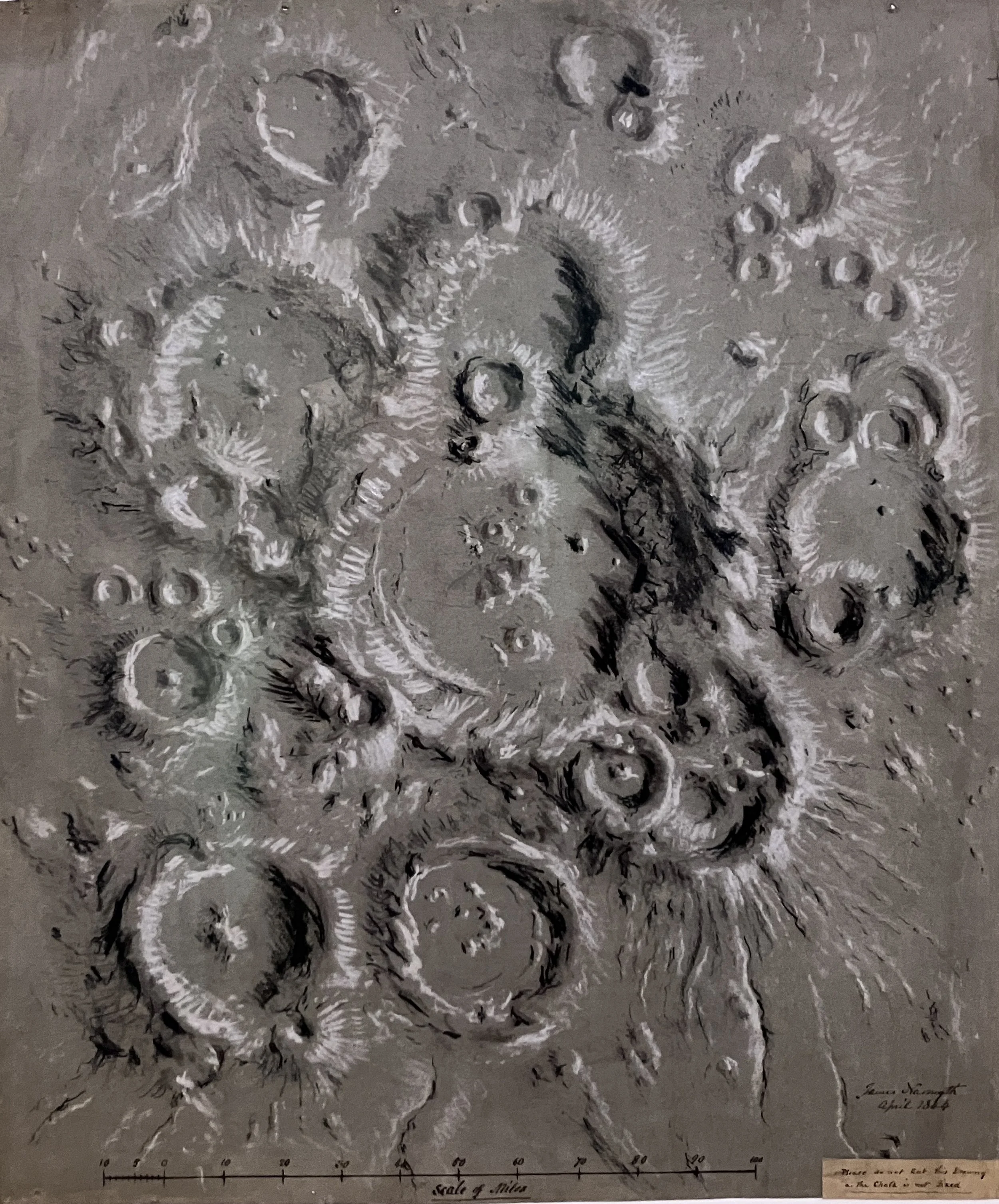
James Nasmyth lunar drawing, 1844. Royal Astronomical Society.
Both artists and scientists are fascinated by the world around us. Both observe and interrogate the world and show it back to us in new ways. Both use images not only to illustrate but also to produce new knowledge. These ideas are central to my ongoing interest in the intersections between art and science.
They also underpin an exhibition currently on at the Royal West of England Academy in Bristol. Cosmos: The art of observing space has been curated by artist Ione Parkin who is also an Honorary Visiting Fellow of the School of Physics and Astronomy at the University of Leicester. I was privileged to facilitate some of Ione’s research when a curator at the Science Museum, as she and Gillian McFarland explored the collections for their ‘Creativity and Curiosity’ project. In paint, print, paper and glass, they show the cosmos back to us in rich and compelling works.
Cosmos brings together works by contemporary artists with historical works on loan from the Royal Astronomical Society, Royal Museums Greenwich and others, to ‘celebrate the awe and wonder felt in contemplation of the immensity of the universe.’ Artists consider both what we can see in the sky and our technologies for looking at it; both how the cosmos impacts the Earth and our role within it; it’s magic, mystery, meaning, and perhaps menace.
I was immediately struck by textures in the works. John Russell’s luscious pastel of the lunar surface shone out alongside Parkin’s pocked and pitted paper works, Michael Porter’s dense paintings, and Jane Sheppard’s earthy ceramics. Simon Hitchens has brought physical presence and texture to that most transient of images, a shadow, with a stark, black concrete block solidifying the sun’s shadow at its zenith across the gallery floor.
The dense complexity of the cosmos can also be captured in a delicate drawn line. I kept being drawn back to Annie Cattrell’s circling patterns of orbits and the visual connection with William Herschel’s carefully dotted galactic model of the Milky Way. An old friend, James Nasmyth’s rugged close-up lunar landscape in white and black pastel on grey paper, appeared in a new light combined with Susan Derges’s rich and subtle photographic image of stars projected through frogspawn. Different textures of life.
There is also richness and intrigue in repetitive looking at the sky. Tania Kovats’s series of ink and watercolour drawing’s of the changing phases of the moon remind us that the sky is our timekeeper as well as our companion. Drawing connections, Gillian McFarland’s prints turn astronomers’ flat fields (images taken to calibrate lenses) into repetitive evocations of the sky, while Lynda Laird’s installation of glass slides spread hundreds of stars at our feet. Looking down rather than up creates a surprisingly different relationship with our stars.
The oldest item in the show is a piece of the cosmos itself: a 4.2 billion year-old meteorite. Small and dark it is visually slightly underwhelming for the vastness of time and space that it holds. But this small, mighty rock reminds us that it is the artworks around it, the products of human imagination and ingenuity, and the centuries of investigation by artists and scientists, that bring the mysteries of the cosmos to life.