V&A East - a store experience
Earlier this year, I took my team for a visit to Hew Locke’s exhibition ‘What have we here.’ at the British Museum. It was a thought-provoking commentary on what is in museum collections, why, and how that knowledge is held and communicated. We were lucky to have a tour from the two curators, who talked to us about the approach to labelling, discussion of provenance, display and design. As a group we particularly took to the exhibition design that strongly evoked the experience of being in a museum store, complete with racking, crates, plastazote packing sheets of tyvek wrap. Yet we wondered how much this would resonate with a visitor unfamiliar with museum storage, or indeed whether that mattered.
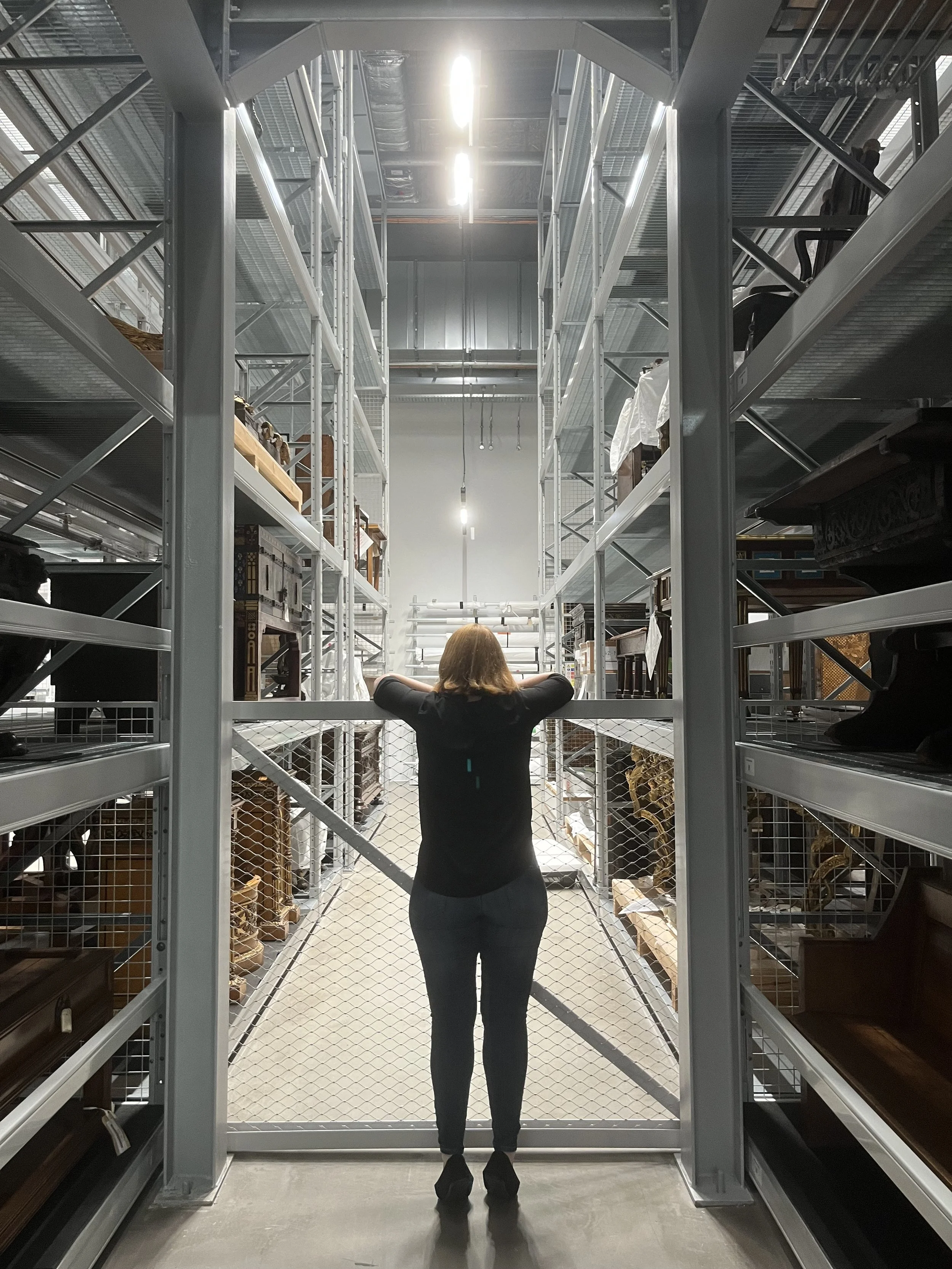
I remembered this recently on a much-anticipated visit to the V&A’s new Storehouse East, the opening of which took over much of my instagram feed. It is immediately visually spectacular. Visitors ascend a set of stairs straight into the heart of the store, essentially entering a glass box cut into the centre of the building. From this stairs and corridors take you into select areas from which you can see through to further spaces. Entering is a ‘wow’ moment, especially with the glass floor giving access to further layers under your feet. Incidentally, I really liked the quirky touch of displaying 2D works flat on the top shelves under this floor, facing up to the viewer.
The store has been structured around four large architectural objects, which are now permanently installed here. The opportunity to see the 15th-century carved and gilded Torrijos ceiling is particularly compelling, as you see the surprisingly rough and ready wooden back of the dome, as well as the intricate interior. This single object gives a real sense of the complexities of object storage and installation. An enormous back cloth for the ballets russes based on a work by Picasso also hangs in a room of the store, which will be used to show rotating stage cloths and large textiles (although this was easy to miss with the signage above head height).
Perhaps inevitably the experience is focused on large objects, with a strong focus on furniture. The ends of shelving adjacent to the central space have been cleverly designed to resemble open packing cases, where some smaller objects are displayed. Selections of objects like mugs and shaving equipment help to make the collections more personal here amongst the rows of exquisite furniture. I was disappointed, though, not to have more access to the vast riches of the smaller and 2D collections here. Cabinets and roller racking are tantalisingly visible beyond the central shelves but out of reach.
The shelving ends are also used for small curated displays, which open up museum practices and processes, and raise questions. I liked the focus put on the voices of different staff and highlighting the work of teams including technicians, conservators, and visitor assistants. Routes through the store take you to windows looking down onto the study room and conservation studio, hopefully at a high enough level to be in balance with the needs of those working within. I know from colleagues that such ‘staff at work’ spaces in museums can be under-used as staff find working in public view challenging, so it will be interesting to see how this develops.
The store has been heralded as revolutionary in the easy public access that it gives to stored collections. This is both in the ability simply to turn up to visit 7 days a week, and in the ‘order an object’ facility to look at any 5 objects from the collection. I am looking forward to trying this, and will be really interested to see the data on who uses the service, what objects are looked at, and how the process is managed and maintained.
Ultimately, I am aware that I am a privileged visitor in this space, used to accessing museum stores and confident with how to use them. But I left feeling sad that visitors have such a ‘curated’ experience even of this exceptionally open store, unable really to roam far, see most of the smaller objects, open drawers and cupboards or pull racks. I do realise the latter would be logistically very complex, but so is object ordering.
I’m also interested in the choice to add a layer of digital interpretation through QR codes. This undoubtedly adds important further information, but I wondered why this doesn’t use the existing infrastructure of the collections online, inviting visitors to search by object number, which would give immediate engagement with existing museum tools and processes.
Alongside this web layer, the curated displays add voices and nuance to the collections, raising questions and inviting comment, like Hew Locke at the British Museum. But I left wondering if visitors are truly experiencing a museum store if reliant on this curated layer. Perhaps it doesn’t matter if there are additional riches of a store here of which visitors aren’t aware? Perhaps it does? I think the answer will rest in how the store evolves as objects and visitors come and go, and questions continue.